Cookie Consent Tools
A cookie banner asks your visitors for permission before ad networks, embedded video players and analytics tools drop their trackers. Adult sites load plenty of these third-party services, and each of them has to wait for the visitor’s answer before it runs. The tools listed here display the consent banner, hold back the affected scripts and remember the decision. They differ in how they install, as a JavaScript library or a WordPress plugin, in the proof of consent they keep and in the features locked behind their paid tier.
Pages checked on October 2, 2026
 complianz.io
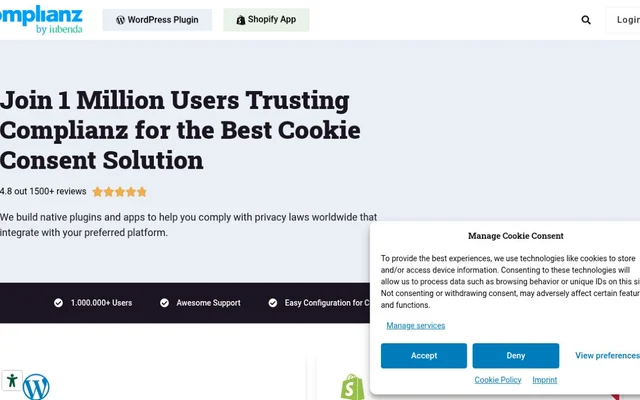
Complianz is a WordPress cookie consent plugin with more than a million active installs, published by Complianz B.V. in the Netherlands, part of the iubenda group. The free version blocks scripts and iframes before consent under one privacy law. Premium starts at $59 a year for one site and adds geo-targeted banners, Google Consent Mode v2, IAB TCF and consent records.
WordPress pluginPrior script blockingEmbedded content blockingCookie scannerGeographic rulesGlobal Privacy Control
 wordpress.org/plugins/warder-cookie-consent
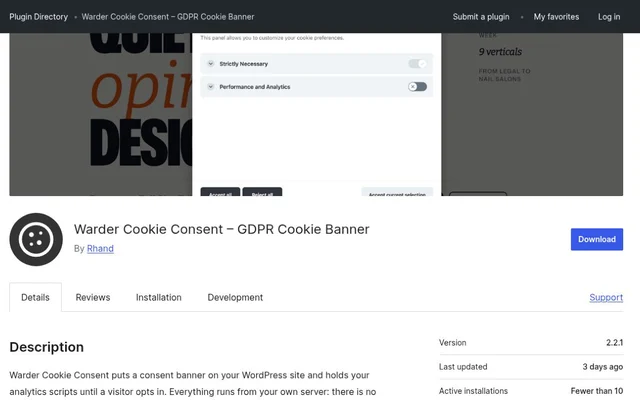
Warder Cookie Consent is a free WordPress plugin that wraps the CookieConsent v3 library in a settings screen. It blocks tagged scripts before consent from your own server, with about 18 KB of gzipped script and no external requests. It keeps no consent records, sends no Google Consent Mode signals and has no CCPA flow.
WordPress pluginPrior script blockingOpen-source licenceNo external account
 wpconsent.com
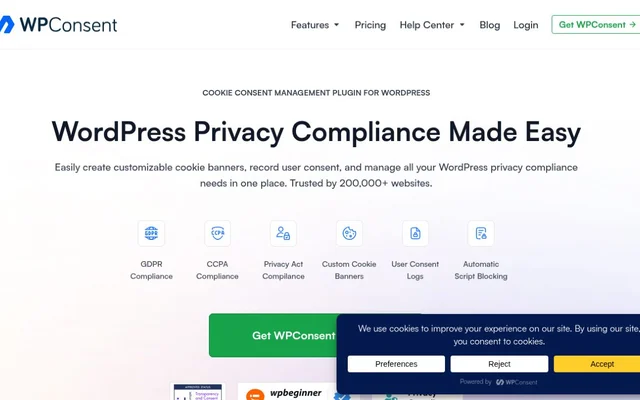
WPConsent is a WordPress cookie consent plugin on more than 200,000 sites, co-founded by Syed Balkhi of Awesome Motive. The free version blocks recognized trackers, scans your pages and handles Google Consent Mode v2 and GPC. Paid licences, listed at $99 to $599 a year, add consent logs, custom blocking rules, geolocation, a Do Not Sell addon and IAB TCF v2.3.
WordPress pluginPrior script blockingEmbedded content blockingCookie scannerConsent logsGlobal Privacy Control
 consentos.dev
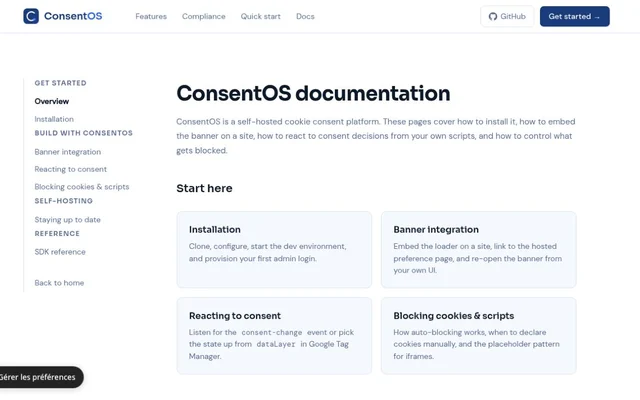
ConsentOS is a self-hosted consent management platform from Slate Data Ltd in London, source-available under the Elastic License 2.0. It bundles a banner, a cookie scanner, consent records and multi-site administration, speaks IAB TCF v2.3, GPP and Google Consent Mode v2, and is at version 0.3.0.
Consent backendPrior script blockingCookie scannerConsent logsGeographic rulesGlobal Privacy Control
 tarteaucitron.io
tarteaucitron.js is an open-source consent manager under the MIT license, built in France by Amauri Champeaux since 2014. It blocks more than 220 services until the visitor chooses and ships in 36 languages. The Pro licence covers unlimited sites and traffic for €25 a month up to €690 for life, excluding VAT.
JavaScript libraryPrior script blockingEmbedded content blockingMultilingual supportGoogle Consent ModeOpen-source licence
 mooveagency.com/wordpress-plugins/gdpr-cookie-compliance
GDPR Cookie Compliance is a free WordPress plugin from Moove Agency in London, active on more than 300,000 sites. It keeps visitor choices on your own server and injects the scripts you give it only after consent. Premium licences run from £59 to £499 a year, with no limit on page views.
WordPress pluginPrior script blockingConsent logsGeographic rulesGoogle Consent ModeWP Consent API
 silktide.com/consent-manager
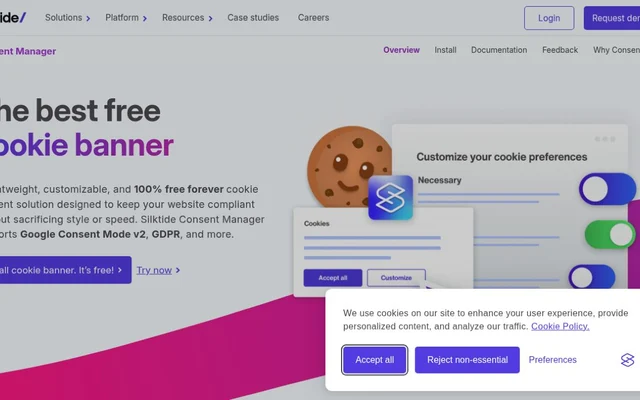
Silktide Consent Manager is a free, MIT-licensed cookie banner from Silktide, the web governance company with offices in Austin and Birmingham. One 53 KB JavaScript file and an 11 KB stylesheet run it with no account and no traffic limits. It drives Google Consent Mode v2 for you, but keeps no consent records and only holds back scripts you hand it.
JavaScript libraryGoogle Consent ModeGoogle Tag ManagerOpen-source licenceNo external account
 cookie-compliance.co
Cookie Compliance for WordPress, formerly Cookie Notice, runs on more than 800,000 sites and connects to an online platform run by Hu-manity Rights, Inc. in the US. The free plan blocks trackers for the first 1,000 visits in each 30-day cycle. Professional costs $14.95 a month for one domain and adds Global Privacy Control, Meta and Microsoft consent modes.
WordPress pluginPrior script blockingConsent logsGlobal Privacy ControlGoogle Consent ModeWP Consent API
 cookieconsent.orestbida.com
CookieConsent is a free, MIT-licensed JavaScript consent banner by independent developer Orest Bida, published on npm as vanilla-cookieconsent. Its 10 KB gzipped script holds back tagged scripts until the visitor agrees and supports opt-in and opt-out modes. Translations, consent records and country detection are left to you.
JavaScript libraryPrior script blockingGoogle Consent ModeOpen-source licenceNo external account
 c15t.com
c15t is an open-source consent management library under the Apache 2.0 license, maintained by Inth in San Francisco. It ships a ready banner for React and Next.js, holds back scripts, iframes and network calls until the visitor decides, and switches between opt-in and opt-out by region. Inth’s hosted backend is free up to 5,000 sessions a month.
React and Next.jsConsent backendPrior script blockingEmbedded content blockingGeographic rulesGlobal Privacy Control
 klaro.org
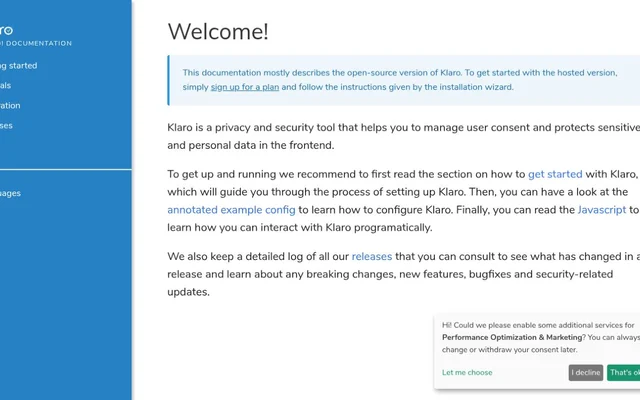
Klaro! is a consent manager from KIProtect GmbH in Berlin whose banner is open source under the BSD 3-Clause license. It holds back scripts, images and iframes until consent, ships in 23 languages and deliberately skips IAB TCF. Klaro Cloud adds consent records and scans from €19 to €299 a month.
JavaScript libraryPrior script blockingEmbedded content blockingMultilingual supportGoogle Consent ModeGoogle Tag Manager
 devowl.io/wordpress-real-cookie-banner
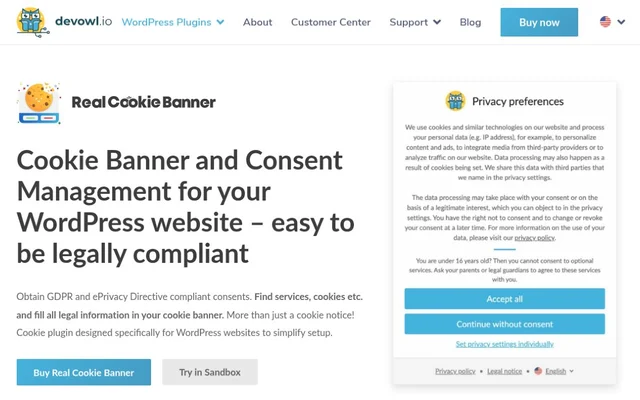
Real Cookie Banner is a WordPress consent plugin from devowl.io GmbH in Bavaria, active on more than 100,000 sites. The free version blocks content by URL and documents every consent in your WordPress database. PRO costs €59 to €299 a year including VAT and adds service templates, IAB TCF, Google Consent Mode and geo-restriction.
WordPress pluginPrior script blockingEmbedded content blockingConsent logsGeographic rulesGoogle Consent Mode
What a cookie banner is and when the law requires one
A cookie banner is the notice shown on a first visit that tells people which trackers the site uses and asks for their consent where consent is needed. In the European Union, the requirement comes from the ePrivacy Directive, implemented country by country, while the GDPR defines what valid consent looks like. National regulators such as France’s CNIL and Spain’s AEPD publish their own cookie guidance on top.
The word cookie undersells the scope. The rule applies to any technology that stores or reads information on the visitor’s device: HTTP cookies, browser local storage, tracking pixels, advertising IDs and fingerprints built from the device configuration. A site that sets no cookies at all but fires an ad network’s conversion pixel still needs a banner.
Strictly necessary trackers are exempt. Login sessions, shopping carts, a saved language setting, load balancing and the cookie that stores the banner answer itself can run without asking. Some audience measurement also qualifies in France, provided it stays anonymous, serves the site alone and never gets combined with other data.
Everything else needs opt-in consent before it loads. That covers advertising whenever trackers measure the ads, whether personalized or not, along with social sharing buttons, videos embedded from third-party platforms and analytics that pass data back to their vendor. An adult site earning money from ad networks almost always falls into this group.
Most US state privacy laws work the other way round. Tracking may start straight away, but visitors must be able to opt out of the sale or sharing of their data, and California requires sites to honor the Global Privacy Control signal sent by the browser. A site with European and American traffic can show the opt-in banner to the first group and an opt-out link to the second.
An age verification gate and a cookie banner answer separate obligations. The gate controls access to the content, the banner governs trackers, and having one does not excuse the site from the other.
What a compliant cookie consent banner has to show
Rejecting must be as easy as accepting. Accept all and Reject all sit on the first layer of the banner with the same size, the same contrast and the same number of clicks. The CNIL has fined large platforms whose reject option took several clicks while accepting took one. Closing the banner with its cross counts as a refusal.
The first layer names the purposes in plain words, such as analytics, advertising, social sharing and embedded video. It links to the list of companies that set trackers, usually through a second screen. That second screen lets visitors decide purpose by purpose, with every box unticked by default.
Consent requires a clear action. Scrolling, clicking elsewhere or carrying on browsing no longer counts as agreement in the EU. Regulators also target dark patterns: a greyed-out reject button, copy that guilt trips the visitor, a slider that is hard to read or a box ticked in advance.
Visitors can change their mind at any time. A permanent link, often in the footer, reopens the preference panel. The site stores the answer, acceptance and refusal alike, so the question does not come back on every page, and asks again after a reasonable period or when the list of trackers changes.
A cookie wall hides the content until the visitor accepts. European regulators assess it case by case and expect a fair alternative, such as paid access without advertising trackers.
How to block trackers before the visitor gives consent
Prior blocking keeps consent-based services from loading until the visitor has answered. While the banner waits, no ad script runs, no pixel fires and no third-party video calls home. A banner that appears while the tags are already running collects a choice it never enforces.
JavaScript consent libraries work from a declared list. Each service goes into the configuration, and its tags stay inert until consent, usually through a changed script type or an iframe source held aside. tarteaucitron.js, an MIT-licensed library from France, ships with a catalog of ready-made services. Adult ad networks are missing from it and have to be added by hand as custom services.
WordPress plugins often add a cookie scanner that crawls the pages and the installed plugins, then hold back the scripts and iframes they recognize. Complianz does this in its free version. A scan records what loads while it runs. A script that an ad network injects after a few seconds, a player that opens on click or an ad that changes with the visitor’s country slips past it.
On adult sites, trackers mostly come from ad network and pop-under tags, players and thumbnails embedded from tube sites, live cam widgets, affiliate program pixels and analytics. Test the setup in a private window with the browser developer tools open. Before any click on the banner, the network tab should show no request to those domains and the storage tab no third-party cookie.
Google Consent Mode passes the visitor’s answer to Google tags, which adjust their behavior, and Google requires it from advertisers who target European users with its ad products. The IAB TCF framework does the same job for programmatic advertising, sending a standard consent string to the companies in the auction. Both signals only reach tags that read them. The banner still has to block the rest.
Choosing a cookie banner tool: library, plugin or CMP
A JavaScript library runs on any site, sits on the site’s own server and is configured in code, which suits tube scripts, static sites and custom platforms. A WordPress plugin is set up from the admin panel and detects common plugins and integrations. A consent management platform, or CMP, is a hosted service that delivers the banner, the scanner, the reports and the consent log from its own servers, usually on a subscription.
Under the GDPR, the site owner has to be able to show that a visitor agreed. A library that keeps the choice in a browser cookie applies the preference but leaves nothing on the server. A consent log records each answer with its date, the banner version and a pseudonymous visitor ID. Several plugins keep that log for their paid tier, and tarteaucitron.js has none at all.
A banner served by a vendor contacts the vendor’s servers on every visit, passing along the visitor’s IP address and the page being viewed. On an adult site that browsing data is personal, and it reaches a third party before the visitor has chosen anything. A library served from the site’s own domain avoids the exchange. Some WordPress plugins also call their developer’s infrastructure for scanning or usage statistics.
Price the tool on the features the site needs: consent log, region-based banners, Google Consent Mode, IAB TCF, the number of domains the license covers and the renewal rate. A free library costs setup time instead, plus a check every time a new script lands on the site.