Adult Video CDN
An adult CDN keeps copies of your videos and images on servers around the world, so each visitor loads them from a nearby location and your own server survives traffic spikes. The network has to allow adult content in writing, stop other sites from embedding or ripping your files, and bill in a way you can predict as the audience grows. The services listed here cover delivery, encoding into playback formats and running a tube catalogue, building blocks that fit together and each charge on their own terms.
Pages checked on October 1, 2026
What an adult CDN does for a video site
A CDN, or content delivery network, is a set of servers spread across many countries that cache a website’s files and serve each visitor from the location closest to them. Those locations are called points of presence, or PoPs. The site itself still runs on an origin server at a hosting company, with its code, its database and the master file of every video.
Video accounts for most of the bytes an adult site sends. Served from a single machine, every play draws on the host’s uplink, and viewers far from the data center wait longer for a scene to start. A CDN fetches each file from the origin once, caches it, then serves later requests from the edge. A burst of traffic from an aggregator or a social post is spread across the whole network. CDNsun also offers an origin shield, an extra caching layer that cuts the number of requests reaching your server even further.
CDN video reaches the viewer in one of two ways. With progressive download, the player pulls a single video file from start to finish, the same way a browser loads an image. With adaptive streaming, the video is cut into short segments encoded at several quality levels, and the player picks, segment by segment, the level the viewer’s connection can handle. HLS and MPEG-DASH are the two common adaptive formats, and HLS plays on most browsers and phones.
Live streaming takes a separate path. The performer’s or studio’s encoder pushes a continuous feed, usually over RTMP, to an ingest point on the network, which repackages it as HLS and fans it out. A cam site needs that piece, while an on-demand tube can skip it. CDNsun handles both live and on-demand video, and still supports older protocols such as RTSP for legacy players and IPTV boxes that newer networks no longer feed.
The usual split puts bunny.net in charge of images, videos and static files while an origin host runs the site. A server with a large bandwidth allowance can also carry a tube without any CDN. At adult hosts that bundle generous transfer with each server, the delivery network is often unnecessary, and the CDN earns its place mainly by bringing files closer to a scattered audience.
Which CDNs allow adult content
A CDN that allows adult content states it in its acceptable use policy, the document listing banned material and the grounds for suspending an account. Silence in the terms grants nothing, so ask support in writing before you point a catalogue at the network.
Read the permission in full, because it often sits next to a ban on obscene material. CDNsun accepts adult content and still keeps that ban in its terms, as other video providers do, with nothing explaining how the two rules fit together.
Legality is measured against whichever law the provider picks. CDNsun, a Czech company, allows adult material that is lawful in the Czech Republic. bunny.net, based in Slovenia, requires content to be legal in Slovenia and in every American state. A European publisher with no business in the United States is therefore held to US record-keeping rules for performers and to state age verification laws.
Anything illegal stays banned on every adult friendly network, starting with material involving minors. Some policies add broad wording on top, such as the catch-all category in the bunny.net policy, which the document never defines.
The terms also spell out how an account ends. The bunny.net agreement allows termination without notice and deletion of your data, while the complaint procedure it describes forwards a report to the customer first and cuts access only when there is no reply or a repeat offense. At CDNsun, illegal content means immediate suspension, with or without a refund of remaining credit. A full copy of the library on an origin you control lets you move delivery to another network by changing a DNS record, with no need to upload the videos again.
A specialist host that sells its own CDN puts origin and delivery under one contract. Billing gets simpler, and a suspension then takes down the site and its videos at the same moment.
Encoding, HLS streaming and protecting adult video
Encoding turns the master file into several resolutions and bitrates, packages them as HLS or MPEG-DASH, and produces everything a tube shows around the scene: thumbnails, hover sprite sheets, animated previews. The work can run on your own server with FFmpeg, on a network that transcodes for you, or through a dedicated API.
A transcoding API takes a file URL and returns the renditions, HLS and MPEG-DASH packages, thumbnails and animated previews straight into your own storage. It delivers nothing to viewers. Some accept only finished files, so live input is out. CDNsun includes transcoding in its delivery price, and bunny.net bundles encoding and a player with its video product. A tube already delivered by a network that encodes has no need for a separate API.
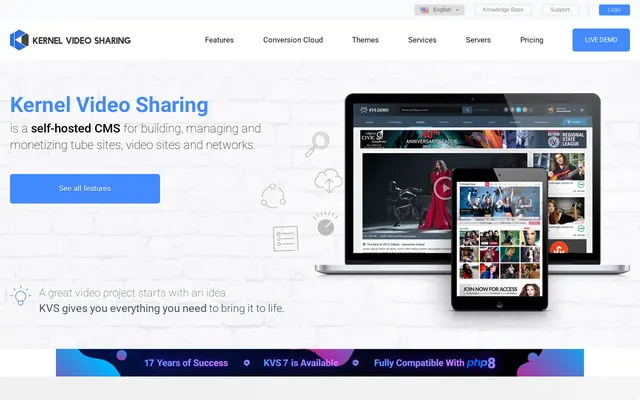
The catalogue itself runs on a tube CMS. KVS installs on your server and handles imports, the player, member accounts, ads and video conversion, uploading converted files straight to the storage server. That storage can be local, remote or object storage, and any CDN plugs in behind it.
Hotlinking is another site embedding your files, showing your videos to its visitors on your bandwidth. The basic defense checks the referrer, the page the request comes from, and rejects unknown domains. Signed URLs go further: a token in the address grants access for a set period and can be locked to the viewer’s IP address. CDNsun offers a variant that places the token in the path, which protects a whole HLS stream. The token is checked when the connection opens, so a download already underway finishes, while an HLS player stops as soon as it cannot fetch the next segment.
Tube scripts and video platforms stack their own protections on top. KVS combines encrypted or expiring links, anti-hotlink rules, domain blacklists and referrer checks, and its player obfuscates file URLs against grabbers. bunny.net blocks downloads and ties playback to a token through Media Cage. For a paysite, some specialist hosts watermark each video as it is delivered, so a leaked file can be traced back to the member who took it.
Country filtering rounds out the setup. CDNsun takes an allow list or a block list of countries for each service, and KVS applies geoblocking by country. KVS also configures its age verification integration by country, state and domain, which maps onto the way American age verification laws differ from state to state.
The factors behind an adult CDN bill
An adult CDN bills per gigabyte delivered, meaning outbound traffic to viewers. Inbound traffic, the upload of files to the network, is usually free. Some networks add a per-request fee, which hurts a tube that serves huge numbers of small HLS segments and thumbnails. CDNsun and bunny.net charge nothing per request.
The price per gigabyte depends on where the viewer is. Europe and North America cost the least, Asia, South America and Africa noticeably more. An audience concentrated in Latin America or Southeast Asia pays more for the same video. Switching off regions you do not need lowers the bill: bunny.net turns each region on or off with one control, and CDNsun goes down to individual cities.
Volume brings the rate down on some networks. Some specialist hosts that sell their own CDN use tiered pricing based on monthly volume. bunny.net runs a second, cheaper network with far fewer PoPs, suited to a heavy catalogue served to a concentrated audience. CDNsun keeps the same unit price whatever the volume.
Origin storage is billed separately. CDNsun storage works only as a source for the network, and serving the public straight from it can get the account suspended. At bunny.net, replicating storage to extra locations multiplies the storage bill without changing the delivery price, and transfer from storage to the network is free.
CDNsun runs on prepaid credit that expires. Once the balance drops below the allowed overdraft, the account is suspended until you top up. Its custom plan works the other way, with a minimum monthly spend. A monthly cap, on bandwidth at bunny.net and on both bandwidth and spend at CDNsun, shields the bill from an unexpected spike or a wave of hotlinking. At CDNsun, a service that hits its cap is suspended until the following month.
Encoding and software come on top of delivery. A transcoding API may charge per output minute, leaving out source minutes and failed jobs. KVS is a one-time perpetual licence, with the server, storage and delivery left to you. A realistic tube budget adds up delivered volume per region, catalogue storage, encoding for every new upload and the origin server, using the same assumptions for each provider you compare.