Adult Email Marketing
Open source email marketing software lets you run newsletters and campaigns from your own server, out of reach of the hosted platforms that ban adult content. These tools handle subscriber lists, signup forms, message editing and reporting, then hand delivery to an SMTP relay of your choice. They differ in license, in how much they automate, from a one-off broadcast to a triggered sequence, and in how much server work they expect from you.
Pages checked on October 5, 2026
 acellesend.com
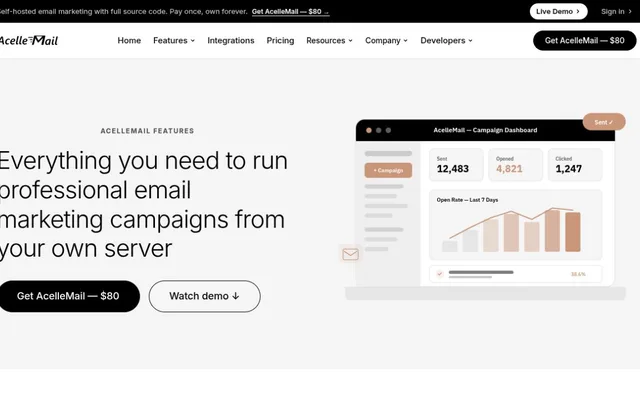
Acelle Mail is PHP and Laravel email marketing software you install on your own Linux server, sold for $80 once as a regular license or $199 as an extended one. Mail goes out through the relay you connect, such as Amazon SES or SMTP, billed separately.
NewslettersMarketing automationSegmentationExternal SMTPAPI accessCommercial license
 openemm.org
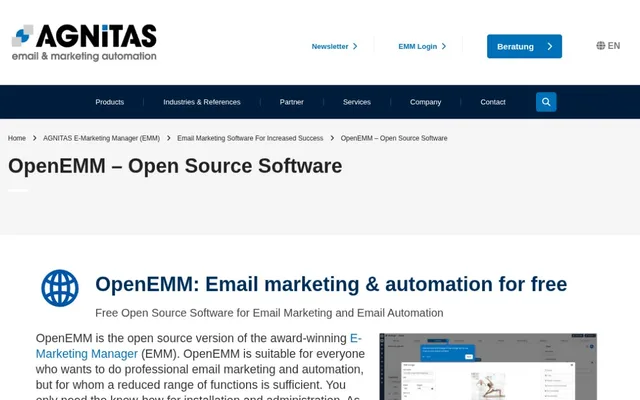
OpenEMM is the free, open source edition of AGNITAS's E-Marketing Manager, licensed under AGPLv3. It sends mail through its own Postfix server, runs on Red Hat Enterprise Linux or AlmaLinux with Java 21 and Tomcat 11, and has been downloaded more than 700,000 times.
NewslettersMarketing automationSegmentationSignup formsBuilt-in mail serverAPI access
 postalserver.io
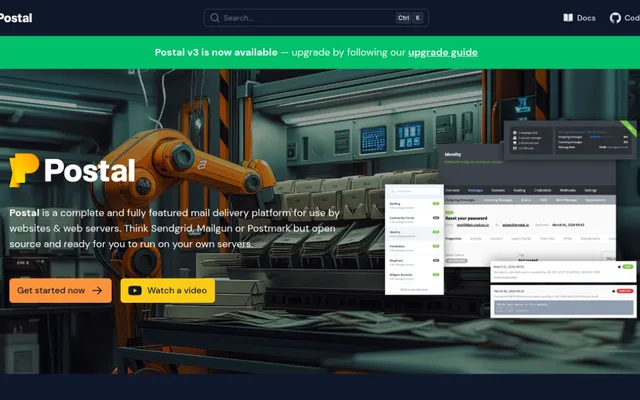
Postal is a free, MIT-licensed mail delivery platform that works like Sendgrid, Mailgun or Postmark on your own hardware. It needs a dedicated server with 4 GB of RAM, Docker and MariaDB, and version 3.3.7 shipped in June 2026.
Mail serverOpen and click trackingAPI accessMulti-userOpen source
 listmonk.app
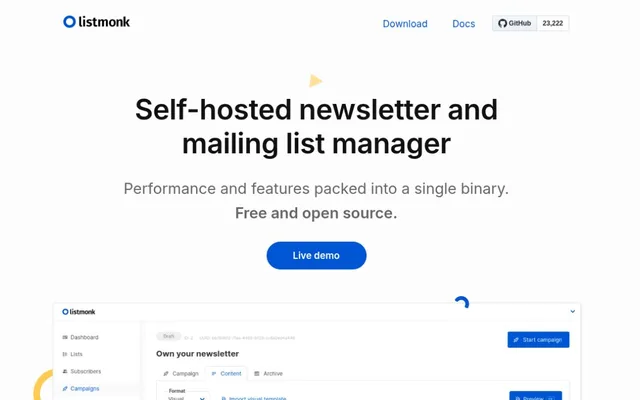
listmonk is a free, open source newsletter and mailing list manager written in Go by Kailash Nadh and licensed under AGPLv3. It ships as a single binary that only needs PostgreSQL 12 or later, and one production install sent a campaign of over 7 million emails with 57 MB of peak RAM.
NewslettersSegmentationSignup formsExternal SMTPAPI accessMulti-user
 mailwizz.com
MailWizz is a self-hosted PHP email marketing application sold since 2013 by Onetwist Software, based in Romania. A regular license costs $59 a year or $79 once, and the extended license for running it as a paid SaaS costs $219 a year or $275 once.
NewslettersMarketing automationSegmentationExternal SMTPAPI accessMulti-user
 mautic.org
Mautic is a free, open source marketing automation platform licensed under GPLv3, which the project says more than 40,000 companies use. You run it on a VPS with PHP 8.2 or later and MySQL or MariaDB, or pay Dropsolid from €247.50 a month for a managed instance.
NewslettersMarketing automationSegmentationSignup formsExternal SMTPAPI access
 keila.io
Keila is an open source newsletter tool from Keila GmbH, a German company, licensed under AGPLv3. You can self-host it for free from a Docker image with PostgreSQL, or pay for Keila Cloud, which runs from €8 a month for 2,000 emails to €256 for 250,000.
NewslettersSegmentationSignup formsExternal SMTPAPI accessOpen source
 dadamailproject.com
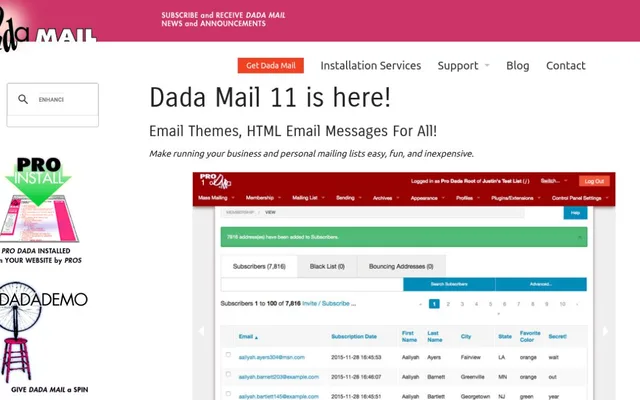
Dada Mail is a Perl mailing list manager under the GPL that runs on ordinary Linux shared hosting. The free version is limited to three lists, Pro Dada costs $150 a year or $300 for life, and the last release came out in September 2023.
NewslettersSegmentationSignup formsExternal SMTPOpen source
 phplist.org
phpList is free, open source newsletter software licensed under AGPLv3, built on PHP and MySQL or MariaDB. Version 3.7.0, released in August 2026, needs PHP 8.1 or later and installs from Softaculous on cPanel hosts that offer it.
NewslettersSegmentationSignup formsExternal SMTPAPI accessMulti-user
Open source email marketing software and its running costs
Open source email marketing software is a newsletter and campaign application whose source code is released under a free license, so anyone can install it on their own server, read it and change it. It covers subscriber lists, signup forms, a message editor, batched sending and open and click tracking, the same ground as a hosted email service provider, with every component running on a machine you manage.
Three licenses cover most of the field. The GPL requires modified code to be published when the software is redistributed. The AGPL extends that duty to people who use the software over a network. The MIT license asks for little beyond keeping the author notice. For a webmaster who installs the tool as shipped, all three mean the same thing in practice: free use with no cap on subscribers.
A second group of self-hosted mailers is sold under commercial licenses, a regular license for mailing your own lists and an extended one for charging clients for access. Their PHP code ships readable and editable, while the license restricts installs and resale, which keeps them outside open source in the strict sense. They still show up in most roundups and install the same way.
For an adult site, self-hosting starts as a question of access. Most hosted email marketing platforms rule out pornographic content in their terms, and several well-known transactional relays reserve the right to close an account whose content they find obscene. A closed account in the middle of a send locks you out of the whole list. With software on your own server, subscribers, send history and templates stay with you, and only the relay depends on a third party.
The software is free and running it costs money: a server or VPS, a sending relay or dedicated IP addresses, and time for updates, backups and bounce monitoring. Sending volume and the relay you pick drive the bill far more than the application does.
Newsletter manager, marketing automation platform or mail server
A newsletter manager sends a campaign to a list or a segment at a set time, then reports opens, clicks and bounces. listmonk is the textbook case: a single binary, a PostgreSQL database, segments written in SQL, and no drip sequences or autoresponders. Triggered messages go through its transactional API, which your site calls on signup or after a payment.
A marketing automation platform adds journeys. A chain of emails fires on signup, after an open, a click or a page visit, with delays, conditions and branches along the way. These platforms often score contacts on behavior and run A/B tests on a message. They handle the welcome series, the win-back mail for a lapsed membership and the follow-up to a reader who clicked without buying. In exchange they need a stronger server, more configuration and a database that grows fast.
A mail server, or MTA, delivers email and manages neither lists nor campaigns. Postal is one: it accepts messages over SMTP or an HTTP API, signs each domain with DKIM, spreads traffic across IP pools and posts every delivery event back to the application through webhooks. It sits behind a newsletter manager in place of a commercial relay.
The easiest tool to run is a newsletter manager, for a site that mails a regular letter to confirmed subscribers. The most complete is an automation platform, for a site that sells memberships and follows up on reader behavior. High-volume senders add a mail server to either one.
Secondary features then separate tools within the same group: a drag-and-drop editor or raw HTML, embeddable signup forms, custom fields for language or preferred niche, multiple accounts with per-list permissions, and relays to SMS or push notifications.
SMTP relays and deliverability for self-hosted email marketing
Open source email software builds the messages and hands them to an SMTP relay, and that relay largely decides whether an email lands in the inbox or the spam folder. An adult site has three routes: a commercial relay whose terms explicitly allow this content, checked before signing up, a mail server you operate yourself, or Postfix on your own machine. The last two leave sender reputation entirely in your hands.
Authentication comes first. SPF lists in DNS the servers allowed to send for your domain. DKIM signs each message with a key whose public half lives in DNS. DMARC tells mailbox providers what to do with mail that fails those checks and where to send reports. Gmail, Yahoo and Outlook require all three from bulk senders, along with a one-click unsubscribe link in the message headers.
A new IP address has no reputation, and mailbox providers judge it on its first sends. A warm-up plan starts with the most engaged subscribers in small batches and raises volume day by day. The software enforces it through an hourly or per-minute rate limit, which also keeps you inside a relay quota. A subdomain reserved for campaigns keeps their reputation apart from the transactional mail sent by the site.
Many VPS providers block outbound SMTP by default to fight spam. You either ask support to open the port or route through a relay on the authenticated submission port.
Bounces are handled automatically: the software reads a dedicated mailbox or receives relay webhooks, tells soft failures from dead addresses and removes the dead ones. Spam complaints follow the same path through mailbox provider feedback loops. A double opt-in list, where every subscriber clicked a confirmation link, keeps proof of consent and filters out addresses typed in by someone else, the two things a relay looks at after the first complaint.
Installing, migrating and maintaining open source email software
These applications run on a Linux server. Older ones are written in PHP on MySQL or MariaDB, install on ordinary hosting and rely on a cron job to trigger sends. Newer ones ship as Docker images with PostgreSQL, or as a single binary. A small VPS is enough to start, then the database grows with every recorded open and click and can slow the admin screens of a large list unless it is maintained.
Check the date of the latest release and of the last commit before installing. Several tools that still appear in roundups have gone years without an update, and a mailer exposed to the internet without patches stays open to known flaws. An unprotected signup form fills up with bot addresses that drag down sender reputation on the next campaign.
Day-to-day upkeep covers a database backup before every upgrade, system patches, the HTTPS certificate on public pages and a watch on the sending queues. Admin accounts belong to trusted people only, since permission to write queries or templates opens the entire list.
A list leaves a hosted provider as a CSV file and enters the new software through the import screen or the API. Import the unsubscribes and complaints first, as a blocklist, so nobody who opted out elsewhere gets mail after the move. Keep the confirmation status of each subscriber as it was, which avoids sending a second confirmation request to people who already confirmed. Useful columns such as country, language, signup date or membership tier become custom fields ready for segments.
The public pages of the software, campaign archive included, sit outside any age gate and should show nothing explicit. Subject line and preview text appear in the inbox before anyone opens the mail, often on a shared screen. Anonymous open and click tracking, where the software offers it, cuts the data kept on each subscriber.