Adult Traffic Exchanges
An adult traffic exchange sends visitors to your site in return for the visitors you send out, with no ad budget involved. Between adult sites it usually means traffic trading: a script on your galleries, toplist or tube counts what each trade partner sends you and pays it back with a share of your outgoing clicks. Trade scripts differ in how finely they tune returns, how hard they fight cheaters and how old their code is. Credit based surf exchanges, where members earn visits by viewing each other's pages, run on different rules and draw a different crowd.
Pages checked on October 3, 2026
What an adult traffic exchange is and how it works
A traffic exchange is a system in which webmasters send visitors to one another instead of buying them. The term covers two different models. The first is the credit based exchange, often called a surf exchange or autosurf: a central platform rotates its members' pages, and every page a member views earns credits that are spent on visits to that member's own site. The second is traffic trading, a direct swap of clicks between adult sites, run by a script installed on each site.
On a credit exchange, a member adds a site, views other members' pages for as long as a countdown timer demands, and watches those credits turn into views of the submitted page. The rate at which pages viewed become visits received is called the surf ratio. Paid memberships usually get a better ratio, and most platforms also sell credits outright, which turns the exchange into a cheap way to buy page views.
Manual surfing requires a click to load each new page, often after a quick check such as typing a code or picking a matching image, to prove a human is watching. Autosurf rotates pages by itself in an open window, and the member collects credits without looking at anything. Manual exchanges deliver slightly more attentive visitors. Autosurf delivers volume.
A visitor on a credit exchange is there for credits. The page sits in a frame for a few seconds before the next one loads. That traffic can put a banner, a squeeze page or a brand name in front of people, and it rarely sells a membership.
Adult traffic trading works with a different audience. The visitors being swapped belong to the partner sites and came for videos or galleries, and every site returns part of its outgoing clicks to the sites that feed it.
Adult traffic trading: ratio, skim and toplists
Traffic trading connects sites that share a niche: TGPs and MGPs, toplists, link sites and tubes. Each site links to its trade partners, and a trade script counts the visitors every partner sends, tracks what those visitors click, then sends each partner a share of the outgoing clicks. A partner that sends plenty of active surfers gets plenty back. A partner that sends little gets little.
The ratio is the return promised to a partner relative to the visitors it sends. Skim is the share of a surfer's clicks routed to trade partners instead of the site's own galleries or videos. Productivity, or prod, is the average number of clicks per incoming visitor. Quality compares the clicks a partner's surfers make on your site with the visitors you send back. Forces push a set amount of traffic to one partner, either to start a new trade or to honor a deal.
A toplist ranks partners by the hits, clicks or quality they bring and shows that ranking on the page. A partner near the top receives more clicks, so every partner has a reason to send more. New trades are arranged on adult webmaster boards, several of which keep a section for traffic trades and gallery requests.
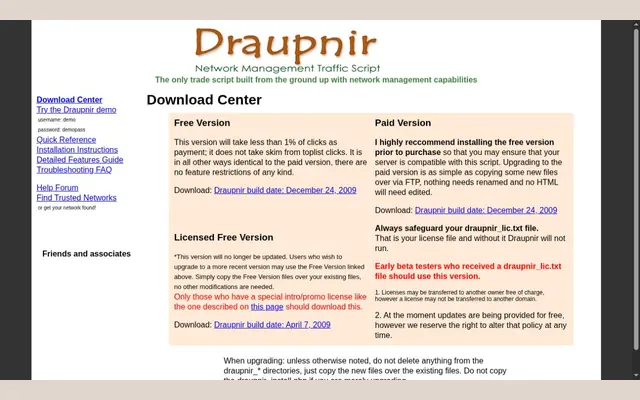
A trade script runs on the webmaster's own server and brings neither partners nor surfers. A site with no trades gets nothing back. DraupnirSoft, for example, is a PHP trade script that handles ratios, skim, forces and toplists, ties several sites owned by one webmaster to a master install, and can accept another webmaster's network as a trusted network. It is no longer updated and still requires an old PHP release, so it belongs on an isolated test server before it goes near a live site.
Before installing any trade script, check the PHP version it requires, the date of its last release and whether its source code can be read. An encoded script sitting in the site root and run by a cron job cannot be patched when a security hole turns up.
Cheating and low quality traffic on traffic exchanges
Cheating on a traffic exchange means taking real visitors while sending none in return. In traffic trading the usual methods are bots that fake hits, cheap bought traffic routed through proxies, surfers from languages the partner does not target, and pages opened behind the visitor's back in a popup or a hidden frame.
Trade scripts fight back with thresholds. A partner is switched off when its proxy share goes above the set limit, when its unique visitors drop too low, when its prod falls outside the normal range or when too few of its surfers speak the expected languages. A bot detector tests visitors on the fly, and a suspicious visitor is sent to the site's own content. Blacklists block a domain, an IP address or words in a site's name, and some blacklists are shared across every site in a network.
The more complete scripts also guard the signup form. A new partner starts on a low ratio until the checks have enough hits to judge it, and a trade only switches on once the first visitor arrives, which filters out webmasters who want a link without sending traffic.
On a credit exchange, the visitor stays for the countdown, rarely clicks, and part of the hits come from autosurf windows left running with nobody at the screen. Site analytics show it: very short visits, a high bounce rate, few conversions. A site that sells its audience to advertisers ends up with inflated numbers made of visits nobody watched.
Before adding an adult site to a credit exchange, read its terms of service, which state whether adult sites are allowed.
Traffic exchanges, AdSense and Google search
Google AdSense advises publishers against traffic exchange services and prohibits any method that artificially generates ad impressions or clicks, including paid to click, paid to surf, autosurf and click exchange programs. An account receiving that traffic risks being closed. AdSense does not accept sexually explicit content in the first place, yet the same logic applies to any ad network that bills advertisers per impression or per click. A banner shown to someone surfing for credits is worthless to the advertiser, and ad networks work to strip those impressions out of their counts.
An adult site paid per thousand impressions or per click therefore gains little from mixing credit exchanges with advertising. Traffic trading raises the issue far less, because the swapped visitors are looking for content and the script's checks remove bots and proxies before any traffic is sent back.
On the search side, Google's spam policies list excessive link exchanges, the “link to me and I'll link to you” kind, among link schemes. Trade links usually go through the script, which counts the click and then redirects the surfer, and their job is to move visitors between sites. A partner page built only to swap links falls under the spam policy. Hits from a credit exchange bring no link to the site and do nothing for its rankings.
The best adult traffic exchange is one whose partners publish content in the same niche and the same format, galleries with galleries and tubes with tubes, and whose checks keep bots and proxies out. For a network of sites that already send each other surfers, a well tuned trade script replaces a spreadsheet of partners. For putting a landing page in front of other webmasters or checking how it displays, a credit exchange is enough. For selling memberships, it sends too few buyers.