
Bunny Stream
bunny.netBunny Stream forms part of bunny.net’s video offering, whose bill combines storage and delivery traffic priced by region.
A VAST video player shows your videos on your own site, serves video ads from any ad network and helps protect your catalog, and every player listed here accepts adult content. Some are open source HTML5 players you drop into any page, some are WordPress plugins that control several video hosts, and some come bundled with a storage and streaming service. Compare them on the ad slots included, the sources they accept, per-domain licensing and copy protection.
Pages checked on October 2, 2026
Tag:
Show allBunny Stream forms part of bunny.net’s video offering, whose bill combines storage and delivery traffic priced by region.

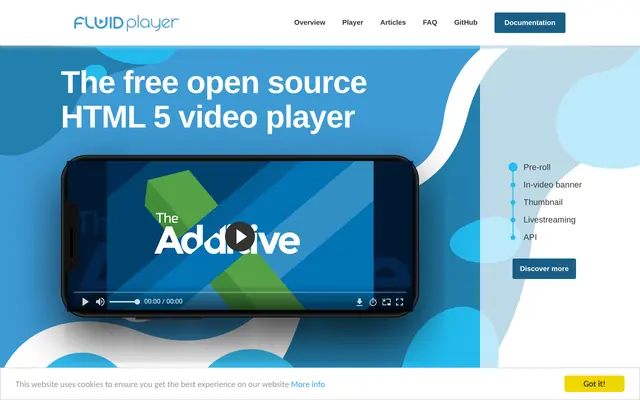
Fluid Player is a free HTML5 video player under the MIT licence, built to sell video advertising. Its recommended setup loads the script from the publisher’s CDN, at an address that always serves the latest version 3.

FV Player is a WordPress video player from Foliovision, in Bratislava. Its free edition already shows Google ads and overlay ads. VAST and VPAID video ads need a separate add-on, billed every year from $150 for one domain.
A web video player is the JavaScript program that displays a video inside the page, with its controls, progress bar, quality menu and, on an ad-supported site, the ads themselves. Desktop software such as VLC lives on the viewer’s computer and plays a different role. Browsers can already play video through the HTML5 video tag, but the built-in controls vary from one browser to the next and handle neither ads nor analytics.
Three families share the market. Open source HTML5 players drop into any page with a few lines of code and cost nothing to license. Fluid Player is one of them, released under the MIT license and built around video advertising. WordPress plugins add an admin screen, shortcodes and often connections to several video hosts. Players supplied by a video streaming service come with storage and encoding, and only play what that service hosts.
A commercial player is usually licensed per domain with a year of updates, and the license removes the vendor’s branding from the screen. An open source player is free and promises no support: help comes through the public repository, and an outage on a Saturday night is yours and your developer’s to fix. The number of sites you run, the support you need and your site’s platform decide between them.
A player stores nothing and encodes nothing. It plays files that are already prepared and sit on a server or a CDN, and bandwidth stays on the host’s invoice. On a tube or any video site, the player and the hosting are chosen together.
MP4 encoded in H.264 plays in every browser, on desktop and mobile. HEVC compresses better but browser support remains patchy, and AV1, more efficient still, encodes slowly and needs recent hardware to decode smoothly. An adult catalog in H.264, with an AV1 rendition for browsers that support it, reaches everyone.
HLS splits a video into short segments available at several quality levels, listed in a playlist. The player measures the viewer’s connection and switches between levels without interrupting playback, which is adaptive bitrate streaming. Safari plays HLS natively, and on other browsers the player often relies on a JavaScript library. DASH does the same job with a different manifest format. A player limited to MP4 sends one file at one quality, too heavy for a mobile connection.
Some players also handle videos embedded from YouTube, Vimeo and other platforms, bringing those sources under a single interface. Others reject any iframe source and only take a file or a stream URL. Where your catalog lives settles that question before you buy.
Script weight affects SEO. A player loaded on every page, with or without a video, slows rendering and drags down the speed signals Google measures. A clean setup loads the script only on pages that play a video, shows a poster image and fetches the video on click. Loading the script from the vendor’s CDN on a URL that always points to the latest release makes every page depend on a third-party domain and pushes updates live without your say. Serving a pinned version from your own domain avoids both.
Player interfaces often ship in English only. Some translate their labels through a language setting, others make you rewrite every label in the configuration.
VAST, short for Video Ad Serving Template, is the IAB standard that defines how an ad server delivers a video ad to a player. The player calls a VAST tag URL, and the ad server answers with an XML document holding the ad creative, its duration, the click-through URL and the tracking URLs. The player runs the ad and reports each event back: impression, start, first quartile, midpoint, third quartile, complete and click. Advertisers pay and publishers get paid on those signals.
A VAST video player places ads at defined moments. Pre-roll, before the video, is the most common. Mid-roll fires at a chosen point, and post-roll fills the remaining inventory. On a tube, a slot triggered when the viewer hits pause shows a banner while they are still looking at the screen. Not every player offers every slot, and some sell advertising as a separate add-on billed yearly per domain.
VPAID added interactive ads that run as JavaScript inside the player. The IAB has deprecated it in favor of SIMID for interactivity and Open Measurement for verification, yet part of the adult ad networks still serve it. Players that support VPAID sometimes ship with it switched off, and VPAID inventory without that setting returns an oddly low fill rate. VMAP describes the full schedule of ad breaks for a video in a single file.
Fallback tags let the player try a second ad network when the first returns nothing, saving the impression. Wrapper chains, where one ad server calls another, are capped by a redirect limit you should set yourself on long exchange chains. The ad response timeout can be shortened for mobile. The most frequent errors are an XML response served with the wrong content type and missing cross-origin headers on the ad server side. Fluid Player, for example, drops a response that is not served as XML and leaves the slot empty.
Adult video catalogs get copied and resold. The first safeguard is URL token authentication, also called signed URLs: the CDN only serves a file when its URL carries a signature and an expiry time generated by your site. A copied URL stops working once it expires, which cuts off sites that hotlink your files and burn your bandwidth.
A watermark overlays your brand or the member’s ID on the picture. It marks the video, and a per-member watermark identifies the account that leaked a file. Download blocking removes the save option and serves the video in segments instead of a single file. None of these measures stops screen recording. Only DRM, Widevine from Google or FairPlay from Apple, keeps the video encrypted up to the screen, at the cost of a license server and a heavier integration best suited to premium catalogs.
YouTube bans pornography and Vimeo bans sexually explicit content, so adult videos embedded from those platforms end up removed and leave an empty player on your page. An adult catalog belongs with a video host or CDN that accepts the business in writing.
FV Player shows the approach that keeps the player separate from the hosting. The WordPress plugin controls very different sources, from Bunny Stream to Amazon S3, from one interface, and its Pro version adds watermarking and URL tokens. A catalog can then change hosts without changing players or editing its pages.
It lists services aimed at people who build adult websites. No pornographic content is hosted here, but the ads shown may be.
Your answer is kept for six months on your device. It is not sent to anyone.