

Is CookieConsent enough for GDPR and CCPA?
It covers the banner and prior blocking, and nothing around them. Orest Bida lists the gaps himself: CookieConsent needs basic JavaScript, ships no default categories or translations, is not a CMP, stores no consent records and does not implement IAB TCF. Google AdSense, Ad Manager and AdMob stopped working with it in January 2024.
Proof of consent is your job. The library keeps the choice in a browser cookie with a consent ID, valid 182 days by default. To log it, you post that ID and the accepted categories to an endpoint you build and store yourself. Accept and Reject buttons carry equal weight by default.
Opt-out for US visitors needs your own country check
CookieConsent runs in opt-in mode by default and can switch to opt-out, where enabled categories run until the visitor objects, as CCPA-style rules allow. It does not detect the visitor’s country. The documentation’s example passes a country code that your server or CDN must supply, then picks the mode. A site behind Cloudflare can read the country header and feed it in.
Which CookieConsent is this?
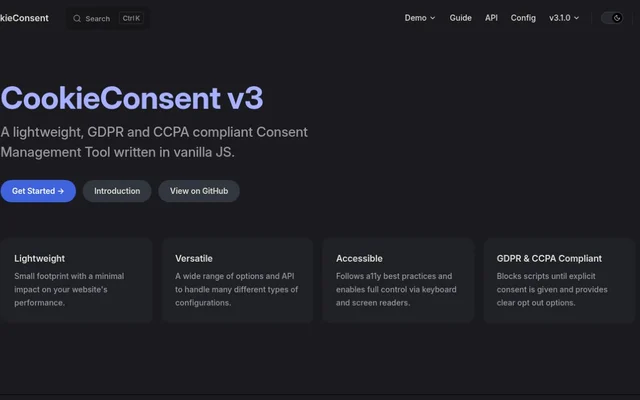
This review covers Orest Bida’s library: npm package vanilla-cookieconsent, 5,600+ GitHub stars and more than 530,000 npm downloads in the last week of September 2026. Version 3.1.0 is from February 2025, with fixes merged in May 2026 but not released. Osano’s older cookieconsent has not shipped a release since 3.1.1 in 2019. Two products share the name and appear in search results for it: cookieconsent.com, a free banner generator from TermsFeed, and CookieConsent by AWORK One, a paid consent platform listed on Software Advice. Neither is related to this library.
CookieConsent strengths and limitations
Strengths
- 10 KB gzipped, no dependency.
- Opt-in and opt-out modes.
- Free under MIT, no account.
Limitations
- No consent records or country detection.
- No translations or default categories.
- No scanner and no IAB TCF.
- No release since February 2025.
CookieConsent or c15t
c15t brings what CookieConsent leaves out: a consent backend, region rules and network request blocking, but its ready banner needs React or Next.js. CookieConsent drops into any site with a script tag. A PHP tube stays with CookieConsent, and a Next.js site that needs consent records moves to c15t.
 Klaro!
Klaro! is a consent manager from KIProtect GmbH in Berlin whose banner is open source under the BSD 3-Clause license.
Read the review Klaro! → tarteaucitron.js
tarteaucitron.js is an open-source consent manager under the MIT license, built in France by Amauri Champeaux since 2014.
Read the review tarteaucitron.js → Silktide Consent Manager
Silktide Consent Manager is a free, MIT-licensed cookie banner from Silktide, the web governance company with offices in Austin and Birmingham.
Read the review Silktide Consent Manager → Complianz
Complianz is a WordPress cookie consent plugin with more than a million active installs, published by Complianz B.V. in the Netherlands, part of the iubenda group.
Read the review Complianz →