

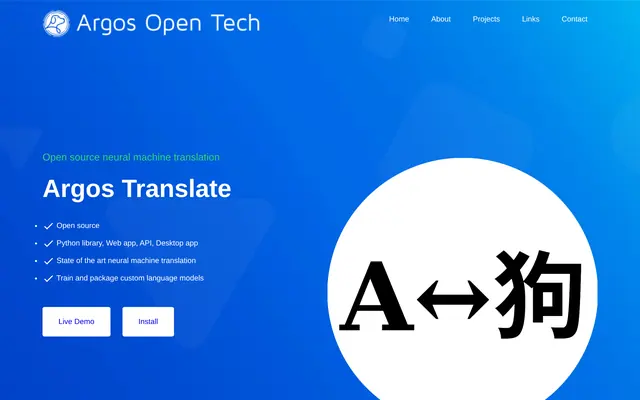
Argos Translate keeps your text on your server
Argos Translate calls no outside service while translating: the model runs on the machine where you installed it. There is no account, no terms of use and no clause about reusing your text, which matters for unreleased scene descriptions or member messages. Hosted engines work differently. Amazon Translate, for example, may keep processed text to improve its models until you set an opt-out policy.
The MIT license allows commercial use without publishing your own code. The software comes as is, with no warranty.
Why English sits in the middle of almost every pair
Of the 100 packages in the public index, 49 translate from English, 49 into English, and only two link other languages directly: Portuguese to Spanish and Spanish to Portuguese. Translating French into German therefore chains two models, French to English and English to German, and each step adds its own errors.
For a US site writing in English, that pivot never happens: one model takes the text straight to the target language. A site that writes in another language pays the double hop on every pair except Portuguese and Spanish. Run fifty of your own titles through the exact pair you need before committing.
How good are Argos Translate models?
Quality varies a lot by language, according to users of LibreTranslate, which runs on Argos Translate models. In an August 2024 issue, one user found German output poor and called the Azerbaijani model “pretty much useless” next to Llama 3. In January 2025 another rated Norwegian to English “quite poor”. The LibreTranslate maintainer has since been testing large language model approaches.
Languages covered by Argos Translate
The index covers 50 languages. Brazilian Portuguese has its own model next to standard Portuguese, and traditional Chinese has one next to simplified. For South Asia there are Hindi, Urdu and Bengali. Smaller languages include Esperanto, Basque, Galician, Irish, Kyrgyz, Swahili and Tagalog. Spanish comes in a single variant.
Setting up Argos Translate
Argos Translate installs as a Python package, for Python 3.5 or later, and then downloads one model per language pair. Models are .argosmodel archives served over HTTP or peer to peer through IPFS and BitTorrent. Once installed, translation works with no internet connection.
It runs as a Python library, a command-line tool or a desktop app. A short script can read a file of video titles, translate them and write the output. The engine is OpenNMT, and published training scripts let you build a model from your own translated corpus.
Who maintains Argos Translate
Argos Open Technologies, LLC owns the project. Its founder, P.J. Finlay, is a developer based in Ithaca, New York, who has run it since 2019 and has also held a full-time software engineering job since October 2024. He sells support, custom model training and managed hosting of a dedicated translation server.
The GitHub repository opened in April 2020, has more than 6,500 stars and received commits in August 2026. Version 1.11.0 of the Python package shipped in February 2026.
Argos Translate strengths and limitations
Strengths
- No text leaves your server, and it works offline.
- Free, with no account or quota, under the MIT license.
- One model hop from English to any of its 49 targets.
- Training scripts for a custom model.
Limitations
- Two model hops between non-English languages, except Portuguese and Spanish.
- Installation and scripting required.
- One Spanish variant, nothing specific to Mexico or Latin America.
- Uneven quality by language, per user reports.
- A single maintainer with a day job.
Argos Translate alternatives in this directory
LibreTranslate wraps the same engine in an API and web interface under the AGPL license. Amazon Translate charges $15 per million characters and covers 75 languages. For copy that has to sell, Adult Translations uses human translators.
 Adult Translations
Adult Translations is a human translation agency that works only on adult content, started in Bratislava in 2015.
Read the review Adult Translations → Amazon Translate
Amazon Translate is the machine translation API of Amazon Web Services.
Read the review Amazon Translate → DeepL
DeepLDeepL is the machine translator from DeepL SE in Cologne, Germany. The free version handles 50,000 characters a month and uses your text for training.
Read the review DeepL → LibreTranslate
LibreTranslate is an open source machine translation API built on Argos Translate.
Read the review LibreTranslate →