

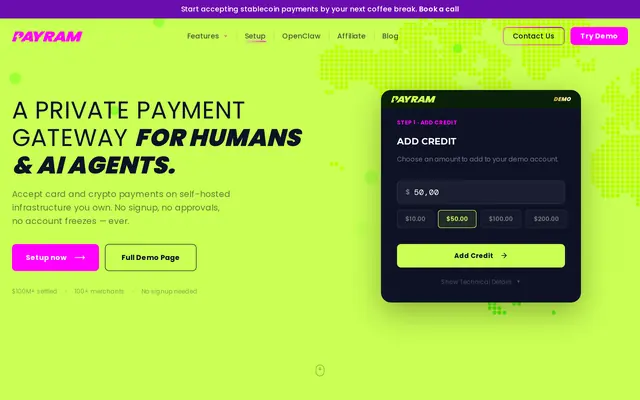
PayRam for adult and high-risk sites
PayRam has a dedicated page for adult businesses, built around payments with no ID checks, no chargebacks and no processor that can close the account. Since the software runs on the merchant’s server and settles on-chain, there is no PayRam account to suspend. PayRam is clear that “no KYC” only means there is no PayRam account to verify: the site’s own KYC, AML and licensing duties still apply, whether it is based in the US, the UK or elsewhere.
What fees does PayRam charge?
PayRam does not publish a price: its commercial terms are discussed privately. It does take a fee, since its affiliate program pays “up to 20%” of the fees PayRam earns from referred merchants. Add a VPS at roughly $20 to $40 a month. For comparison, BTCPay Server, the open-source alternative, charges nothing.
Card payments and supported tokens
Customers can pay by Visa or Mastercard and the merchant receives stablecoins, with no card acquirer to onboard. PayRam lists 175 payment methods for this card-to-crypto onramp. On-chain, it takes BTC, ETH, USDT and USDC on Bitcoin, Ethereum, Tron, Base and Polygon, plus PYUSD, for more than 20 tokens. Lightning is not supported. A crypto-to-bank off-ramp to USD, EUR, AED or INR is still on a waitlist.
Where the money goes
Each customer gets a permanent deposit address of their own. Smart contracts then sweep balances on-chain into a cold wallet only the merchant controls, ideally a hardware wallet. The server stores only public addresses, never deposit keys, and a small hot wallet holding ETH, POL or TRX covers gas for the sweeps. Nobody can freeze those funds, and nobody can recover them if the keys are lost.
Setting up PayRam
Rent an Ubuntu 22.04 VPS with two CPUs from Hetzner, AWS, Google Cloud, Azure or Hostinger, point a domain at it and run the one-line installer. It sets up Docker, PostgreSQL and a free Let’s Encrypt certificate in about ten minutes. A free WooCommerce plugin connects a WordPress store. Development is active: version 3.8.2 shipped in September 2026, with a release log going back to February 2024.
Paying models and affiliates
PayRam also sends payouts from the merchant’s wallet, by hand or through the API. Every payout goes through maker/checker approval, a one-time password and an allow-list of verified recipients, with hourly and daily limits that stop unusual amounts. On-chain payouts are final.
PayRam strengths and limitations
Strengths
- No account to open and nothing to freeze.
- Deposit keys kept off the server, with automatic sweeps to cold storage.
- Native USDT and USDC on Tron, Base and Ethereum.
- Card payments settled in stablecoins.
Limitations
- No published pricing.
- No company named on the site.
- A server to maintain and keys to protect.
- No bank off-ramp yet.
PayRam vs BTCPay Server
BTCPay Server is also self-hosted and charges no fee, under the MIT licence, but it is built for Bitcoin and Lightning and reaches stablecoins only through plugins. PayRam handles USDT on Tron and USDC on Base natively, without a Bitcoin node, at a price it does not disclose.
 Apirone
Apirone is an Estonian crypto payment gateway, running since 2017, that receives each payment on a dedicated on-chain address.
Read the review Apirone → ATLOS
ATLOSATLOS is a crypto payment gateway that sends every payment straight to the merchant’s wallet, with no identity checks and no custody.
Read the review ATLOS → BitHide
BitHide sells a business crypto wallet that the merchant installs on its own server, with a payment gateway, mass payouts and AML screening.
Read the review BitHide → Bitcart
Bitcart is open-source crypto payment software that merchants install on their own server.
Read the review Bitcart →