

Coins BTCPay Server supports
Bitcoin, on-chain and over the Lightning Network, is the project’s focus. Other coins are opt-in and maintained by their own communities: Litecoin, Dogecoin and Dash, plus Monero, USDT on Tron and Zcash through plugins. Exchange plugins also swap other coins into bitcoin, with fees paid by the buyer. Fiat conversion is likewise handled by plugins.
How BTCPay Server works
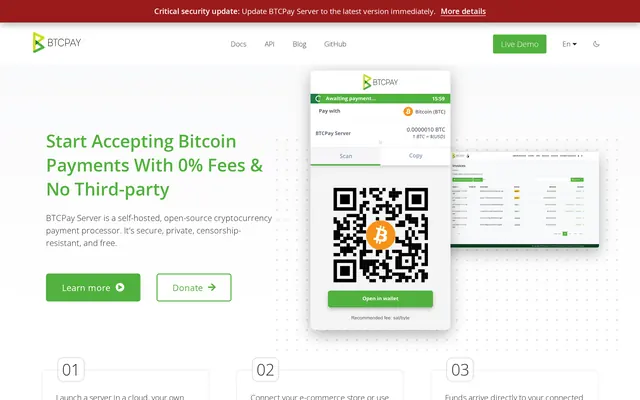
BTCPay Server is an open-source payment processor under the MIT licence, with no fees and no subscription. Payments go straight to the merchant’s wallet with no middleman, and the private key is not needed to receive them. The merchant becomes its own processor and pays only for hosting and network fees.
Deploying BTCPay Server
BTCPay Server runs in the cloud, on your own hardware such as a Raspberry Pi, or with a third-party host. A shared server suits non-technical users, who then rely on its admin. Updates, security fixes included, are the job of whoever runs the server.
Built-in apps
Every instance includes a point-of-sale app, a tipping button, payment links and crowdfunding campaigns. Invoices can be exported for bookkeeping. A built-in wallet supports hardware wallets, and an API automates stores, invoices and users.
Store integrations
BTCPay Server plugs into WooCommerce, Shopify, Magento, PrestaShop, Drupal, WHMCS, XenForo, Ghost and some twenty other tools. Namecheap has taken more than $73 million in bitcoin through it, over 1.1 million transactions.
Getting support
BTCPay Server describes itself as an open-source project with no company behind it, so there is no email, live chat or phone support. Help comes through GitHub and Mattermost, and some community members sell paid support.
Strengths and limitations of BTCPay Server
Strengths
- No fees or subscription.
- No account to open.
- Lightning built in.
- Many store integrations.
Limitations
- Server to keep updated.
- Community-only support.
- Non-bitcoin coins less maintained.
BTCPay Server vs Bitcart and BitHide
Bitcart is also free and open source, with more native tokens, especially on Tron. BitHide is self-hosted too, but sells a paid licence and manages team access. A bitcoin-first merchant looks at BTCPay Server first, one selling in USDT looks at Bitcart.
 Apirone
Apirone is an Estonian crypto payment gateway, running since 2017, that receives each payment on a dedicated on-chain address.
Read the review Apirone → ATLOS
ATLOSATLOS is a crypto payment gateway that sends every payment straight to the merchant’s wallet, with no identity checks and no custody.
Read the review ATLOS → BitHide
BitHide sells a business crypto wallet that the merchant installs on its own server, with a payment gateway, mass payouts and AML screening.
Read the review BitHide → Bitcart
Bitcart is open-source crypto payment software that merchants install on their own server.
Read the review Bitcart →