

CommerceGate’s license and track record
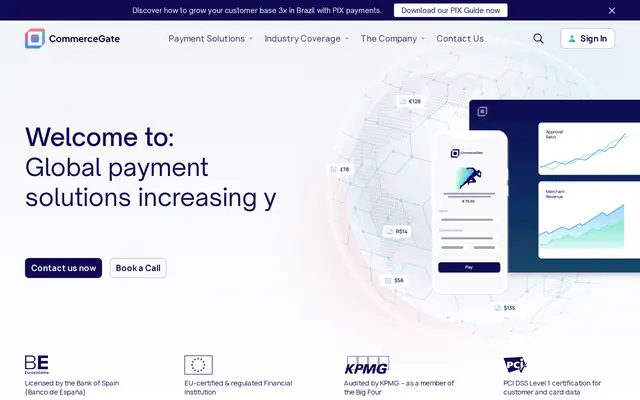
CommerceGate Payment Solutions S.L.U., based at the World Trade Center in Barcelona, is a payment institution licensed and supervised by the Bank of Spain under number 6896. It says it was the first Spanish non-bank group focused on cross-border online payments to get that license, in 2020. KPMG audits it, and its platform has been PCI DSS Level 1 since 2009.
The business started in Barcelona in 2006 and says it was Spain’s largest high-risk processor by 2007. Buyers handle billing questions at cgbilling.com. Trustpilot shows 2.8 out of 5, from only three reviews.
How much does CommerceGate cost?
CommerceGate publishes no rate, reserve percentage or payout delay. An independent review by iGaming Payment Solutions gives working estimates: 2% to 5% per payment depending on method, country and risk, 1% to 2% on currency conversion, a 5% to 10% reserve held 90 to 180 days, settlement in three to seven days, three to six weeks to onboard a high-risk business, and a floor of about $50,000 in monthly volume. Treat them as a starting point for your own quote.
In 2020 CommerceGate told merchants the new Visa high-risk registration would cost $500 a year. CCBill now charges $950 for Visa, so ask for the current figure.
CommerceGate billing and reserve management
CommerceGate boards merchants on its own payment facilitator account or with one of its 20-plus acquiring partners, and adds its billing platform on top. It supports interchange-plus, flat, tiered, geo-based and card-based pricing, with automatic discounts as you reach each volume tier.
The rolling reserve is run by CommerceGate: a percentage of each transaction is held and released automatically on agreed dates. A minimum security deposit can be set, and you can pre-fund the reserve by wire before processing. Payouts go out as SEPA batches generated from approved invoices, in several currencies and to several bank accounts.
Selling into Brazil and Latin America
CommerceGate opened Latin America in 2021 through Brazil, with local acquiring and PIX, then added Mexico, Chile, Colombia, Peru and Ecuador. A European merchant can price, invoice and collect in the buyer’s local currency, with funds coming back in euros over SEPA.
Countries CommerceGate blocks
CommerceGate blocks transactions and merchant accounts from countries on the FATF and EU anti-money laundering blacklists. Since July 2024 that includes Monaco and Venezuela, while Turkey has been removed from the list.
Strengths and limitations of CommerceGate
Strengths
- Bank of Spain license, number 6896.
- Brazil and PIX for European merchants.
- Managed reserve with agreed release dates.
- Automated SEPA payouts.
Limitations
- No published rates.
- A high volume floor according to third-party estimates.
- A thin public review record.
CommerceGate vs Vendo and Verotel
Vendo also offers PIX in Brazil, plus OXXO in Mexico, but publishes no payment license. Verotel publishes its rate, 15.5% on Basic, and holds a Dutch license. CommerceGate combines an EU license with Latin American acquiring, with no public pricing. A European business targeting Brazil should get quotes from CommerceGate and Vendo.
 allopass
allopass is a French company, acting as agent of the payment institution HiPay, that lets adult sites charge buyers on their phone bill through carrier billing, premium…
Read the review allopass → Cardflo
Cardflo is a UK payments partner, based in Wilmslow with an office in Málaga, that places adult, cam and video sites with one of more than 50 partner acquirers and…
Read the review Cardflo → Cashflows
Cashflows is a card acquirer licensed in the UK and the Netherlands and a principal member of Visa and Mastercard Europe.
Read the review Cashflows → CCBill
CCBill has billed adult subscriptions since 1998 and appears as CCBill.com on the buyer’s statement.
Read the review CCBill →