

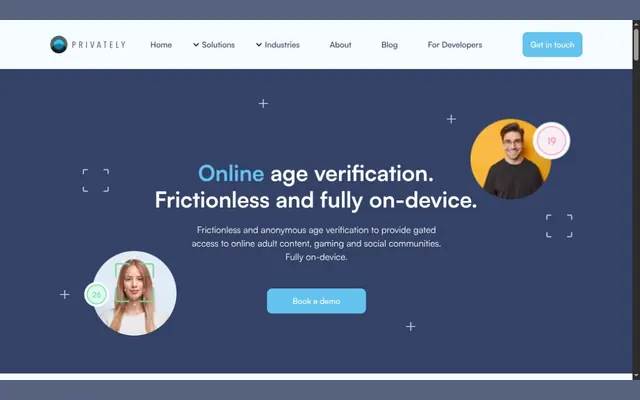
How Privately estimates age without uploading a selfie
The visitor looks at their camera, a small machine learning model estimates their age inside the browser or phone, and the image is created, processed and deleted there. No photo or biometric data goes to Privately’s servers or to third parties, and Privately says it does not train its models on images from live checks. A liveness check runs every time, and a check takes around 30 seconds.
For the web version, Privately keeps a session ID and an age bracket, nothing else about the visitor. A security supplier processes browser-side signals without being able to identify anyone. On mobile, Privately also offers voice-based estimation and a selfie matched to an NFC chip ID.
Why Privately recommends 23+ for an 18 gate
Privately’s documentation sets 23 as the buffer age for highly effective performance at an 18 gate, and 21 for a 16 gate. Germany’s KJM required the same five-year buffer when it approved FaceAssure in November 2022. The engine works in brackets at 16, 21 and 25, and returns the bracket, such as “25+”, with an estimated minimum and maximum age and a transaction ID.
In practice, many 18 to 22-year-olds will be turned away. A UK or US site needs a second method from another provider for them.
Privately in NIST age estimation testing
Privately submitted its model to NIST in January 2026. Its report card shows a mean absolute error of 3.66 to 5.50 years depending on the photo set, with 20% to 37% of 16-year-olds estimated at 21 or older. Those numbers are the reason for the five-year buffer.
Privately’s certifications and Ofcom’s highly effective standard
The Age Check Certification Scheme registry lists Privately for ACCS 2:2021 data protection, valid until 10 April 2027, and for ACCS 1:2025 and ISO/IEC 27566-1:2025 age assurance. Privately ties its 23+ buffer to highly effective performance, the standard Ofcom applies to UK adult sites, and the company also lists UKAS Challenge 25 certification.
How to add FaceAssure to a site
The site opens Privately’s window in an iframe with a signed JWT that sets the target age, theme and timeout. The result is posted back to the page and can be queried later by transaction ID. On desktop, a QR code lets the visitor finish on their phone. The browser experience targets Chrome on mobile and desktop.
How much does Privately cost?
Privately publishes plans but no prices. The free sandbox gives 100 browser checks over four weeks, though images may be backed up on a server during the trial. Deployment covers up to 10,000 checks a month, and Enterprise up to 500,000 with mobile SDKs and custom brackets, both on quote. Privately SA is based at the EPFL Innovation Park in Lausanne and was founded by CEO Deepak Tewari.
Privately strengths and limitations
Strengths
- No selfie leaves the device.
- ACCS and ISO/IEC 27566-1 certification.
- Published NIST results.
- Liveness on every check.
Limitations
- A high threshold that rejects many young adults.
- One method in the browser flow.
- No public pricing.
- Chrome-first browser support.
Privately alternatives: Yoti and AgeVerif
Yoti pairs facial estimation with ten other methods, including card and digital ID, which covers the young adults an estimate turns away. AgeVerif also runs its selfie check on the device and adds card, PayPal and email checks for US visitors, free for the site.
 Incode
Incode is a San Francisco identity verification company founded in 2015.
Read the review Incode → VerifyMy
VerifyMy is a London age assurance company launched in 2019.
Read the review VerifyMy → AgeChecked
AgeChecked is a London age verification company, incorporated in 2016, that checks paysite members in the background while they pay.
Read the review AgeChecked → Yoti
YotiYoti is a London digital identity company offering adult sites eleven age check methods, from a one-second selfie estimate to a credit card check.
Read the review Yoti →