

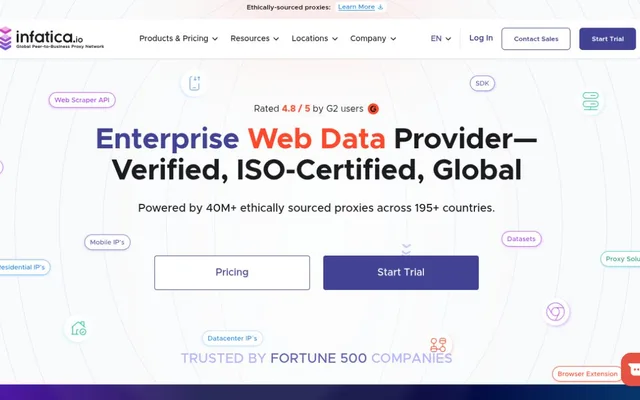
Infatica pricing per GB and per IP
- Residential: pay as you go at $4/GB, then monthly plans from 25 GB at $3.84/GB to 1,000 GB for $2,600.
- Residential IPv6: $6/GB, falling to $3.90/GB on the 1,000 GB plan.
- Mobile: $8/GB, or $800 for 200 GB.
- Shared datacenter: $0.60/GB, or $599 for 2,000 GB.
- Static ISP: $1.95 to $3 per IP per month with unlimited traffic. Dedicated datacenter IPs cost $1 to $1.50.
Annual billing takes 20% off. The four bandwidth networks each come with a 7-day trial, from $3 on shared datacenter to $8 on mobile. Targeting goes down to country, city and ISP, and one proxy list holds up to 1,000 ports.
No account opens without an identity check through Veriff: a photo of a passport, driving licence, ID card or residence permit, then a selfie. There is no way to skip it, and the compliance team can refuse service when the details do not match.
Infatica’s 12-month term and refund rules
An Infatica agreement runs for twelve months, and a customer who cancels early can lose half of the remaining contract value.
Refunds are narrow. None once a trial has started, none more than 10 days after payment, none on payments under $5. ISP and datacenter proxies are sold as is, with no refund and no replacement once assigned, even after a target bans them. .edu, .gov and .mil domains and banking sites stay out of reach, on a list Infatica can change at any time.
Is Infatica P2B malware?
Sophos has detected Infatica P2B as a potentially unwanted application since January 2026. P2B is the SDK that app developers bundle into their software to earn money from their users’ idle bandwidth, and those users make up Infatica’s residential pool. Infatica describes it as a consent-based supply model. Sophos adds that people often discover it installed with third-party packages such as K-Lite Codecs.
The pool is also thin in the United States: 226,090 residential IPs out of the 45 million-plus Infatica advertises, against 274,277 in India and 1,123,823 in Brazil.
Infatica strengths and limitations
Strengths
- Residential traffic with no subscription, billed per GB.
- A paid 7-day trial on every bandwidth network.
- Six proxy networks under one account, IPv6 residential included.
- ISP-level targeting.
Limitations
- Adult sites blocked by default as targets, unless management approves.
- A 12-month term with half the balance due on early exit.
- Almost no refunds.
- A residential SDK flagged by Sophos.
- A small US pool.
Infatica vs Decodo and Oxylabs
Decodo charges the same $4 per GB pay-as-you-go rate for residential traffic. Oxylabs sells monthly plans only.
 Oxylabs
Oxylabs is a Vilnius proxy provider founded in 2015 that claims more than 175 million residential IPs across 195 countries.
Read the review Oxylabs → Decodo
Decodo is the Lithuanian proxy provider known as Smartproxy until April 2025.
Read the review Decodo → Webshare
Webshare sells datacenter, static ISP and rotating residential proxies over HTTP and SOCKS5.
Read the review Webshare → SOAX
SOAXSOAX is a UK company selling residential and mobile proxies paid in credits, with a per-GB rate that depends on your plan and the exit country.
Read the review SOAX →